Showing posts with label System Dynamics. Show all posts

Monday, 7 August 2017

Gems from the deep "making sustainability work"


Learn to present a clearer and more certain picture of the future than sticking your wet thumb in the air


    It can't last forever


    No matter how good the service is and no matter how well the service appears to be meeting demand, sooner or later the laws of system dynamics will come into play and causal loop feedback will catch up with us. Quite simply put: 'it can't last forever'.


    In the above services system model acceptable service quality is limited by capacity, ultimately having an adverse effect on provisioning the service, for instance, not being able to meet the agreed service level. This is typical of the system archetype limits-to-growth.


    How to address it?


    • Use system dynamics to map-out and model service provisioning
    • Try to understand and map-out all the systemic influences involved
    • Consider the dimension of time and see what influence it has on the model(s)
    • Consider the voice of the customer and involve customers with the model(s)
    • Statistics don't lie, obtain as much statistical data as possible
    • Identify trends and patterns of behaviour
    • Walk-through and live-out the various scenarios learned from the models 
    • Pick one that works


    Conclusion


    You've heard the saying "there's no silver bullet"?  Well, try to get as close as you can, maybe there's no guarantee and maybe it's hard to imagine all the "unforeseeable" circumstances, but when you start to use models in this way you can certainly present a clearer and more certain picture of the future than sticking your wet thumb in the air. 
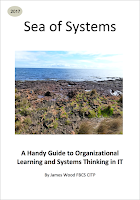
     Check out more great learning tips in my eBook Sea of Systems
    When I started looking at the world through models the penny dropped, the overwhelming feeling was "IT people must know about this". That was in 1994 and I've been banging on about it ever since.

    The system archetypes are in control and it is very hard to do anything about it, but if we don't try, what does that make us? I talk about this in the conclusion of Sea of Systems "well at least I helped this one".

    I explore this and other system archetypes in my eBook Sea of Systems, download it at my blog https://systemsthinkingit.blogspot.com.au

    Monday, 24 July 2017

    Gems from the deep "solution blindness"


    I have noticed that once decisions are made we often forge ahead even when we feel it might not be the right thing to do


    Plus ça change, plus c'est la même chose

    As the French say "the more it changes the more it remains the same"―one of the eternal challenges of managing change and one very good reason to turn to system dynamics and systems thinking as effective ways to understand and control the very real and insidious threat.

    Insidious because the threat is often invisible and undetectable from within the system of change.  More often than not we throw more assets and resources at it, with the attitude, "look, we've made the decision, we all agreed, now we'll bloody-well get on with it".

    Brave and true to the cause, but sometimes, we just need to admit failure, accept failure and above all understand failure.  It is in understanding failure that system dynamics and systems thinking come into their own.  

    Mapping out systemic influences

    The first step in change or intervention is mapping out the systemic influences that could impact the system of change.  When we talk about systems we are using the definition of system provided by Professor Alfredo Moscardini in his foreword to Sea of Systems, a system which can loosely be described as a set of objects that have a common purpose.  

    We are surrounded by systems, not just technological systems but systems of every kind, societal, political, ecosystems in nature. When we embark on a change or intervention we are surrounded by the system of change.  

    In this context systemic refers to any influence that is, has or may potentially impact the system, in any way whatsoever.  You may be familiar with structured change management methodologies, where an impact assessment matrix is used to map-out impacts to business processes according to roles and business units.  

    These impacts are normally limited to areas such as tooling and skilling, however, when we conduct a systemic mapping analysis we must go much further and deeper, as well as forward and backward in time.

    In order to create a solid understanding of our interventions we must build a multidimensional systems model that can be used to actually live-out each scenario for change. It is therefore very important to slowdown using reflective techniques and become aware of the system as it really is.  

    Without the noise and the external pressure to change, we need a clear and unwavering sense of clarity to be able to discern the reality of our systems. Take a BIG step backwards and take some DEEP breaths.

    Inside-out → outside-in

    When we are in the system of change it is sometimes very hard to take a different perspective and all too easy to keeping forging ahead, absolutely determined in our conviction to succeed.  Sometimes however we simply must take stock, and typically we look inwards, with the attitude "right, let's sort ourselves out".  

    It's an honorable intention, but it isn't very likely, given the state we are in.   Remember: plus ça change, plus c'est la même chose―we must look from the outside-in.  

    The key we often forget when we are under-fire is to divorce ourselves from the system and to examine it from the outside-in and from every conceivable perspective and dimension.  

    It is the interconnectedness of the system that is paramount and often we find the interfaces and relationships between the objects of the system and the objects of other systems to cause us pain, not the system itself but rather the way in which the system interacts with the world of systems around it and vice versa.  

    It is when we have a complete and full understanding of these relationships and interactions, especially in the dimension of time, that we can say with any degree of certainty we are making high-leverage interventions. Then and only then can we begin to look at our own system to figure out how to change it to accommodate what the greater world of systems expects from it.

     Check out more great learning tips in my eBook Sea of Systems
    This is difficult but must be addressed, in the fixes that fail example we saw how a successful intervention failed over the mid to long term. 

    There are tools in IT, like post implementation reviews, to record these lessons, but what we really need is to avoid making more mistakes and without thoroughly understanding the systemic impacts  and interconnectedness of our systems we cannot assure that.

    I explore these and other systemic techniques in my eBook Sea of Systems, download it at my blog https://systemsthinkingit.blogspot.com.au


    About — "gems from the deep" takes a quick dive into the more detailed and involved concepts explored in the eBooks Sea of Systems and Transparent Delivery (forthcoming).

    Fixes that fail: decommissioning


    What starts out as a successful quick-win turns into a low-leverage intervention that causes more trouble than its original root cause.  With the advent of IaaS and SaaS the example used in "fixes that fail" seems a little dated, truth being I haven't had time to update it, however the central principles are still valid and very much applicable in our organisations (first published in 2009). 


    Fixes that fail: Decommissioning from Systems Thinking IT


     Check out more great learning tips in my eBook Sea of Systems
    When I started looking at the world through models the penny dropped, the overwhelming feeling was "IT people must know about this". That was in 1994 and I've been banging on about it ever since.

    The system archetypes are in control and it is very hard to do anything about it, but if we don't try, what does that make us? I talk about this in the conclusion of Sea of Systems "well at least I helped this one".

    I explore this and other system archetypes in my eBook Sea of Systems, download it at my blog https://systemsthinkingit.blogspot.com.au

    Thursday, 20 July 2017

    Sea of Systems

    The 2017 edition of Sea of Systems builds on the 2011 edition with enhanced and expanded explanations of Deming cycle, reflection, system archetypes, systemic mapping and systems thinking.


    Creative Commons License
    Sea of Systems by James Wood is licensed under a 
    Creative Commons Attribution-NoDerivs 3.0 Unported License. 
    Based on a work at http://www.solonline.org.
    If you downloaded Sea of Systems and found it useful please donate 
    to help support its future development. Thanks for your support!