Showing posts with label systemic. Show all posts

Saturday, 26 August 2017

Gems from the deep "kiss systemic analysis"


Some simple and straightforward questions that can help to diagnose deeper systemic problems


    When it is difficult to find the root causes of issues ask these questions 

    • Has the issue occurred in the past, how long ago, under what circumstances?
    • What sort of issues are surfacing in your coworkers teams? 
    • Have these issues occurred in the past either in your team or other teams? 
    • How different are the teams where these issues occur/have occurred?

    Use "surfacing" techniques to corroborate the analysis throughout the organisation, this involves asking the same questions to a selection of people at different levels, with different lengths of tenure

    Quite often colleagues experience the same or similar issues throughout the organisation, when they do these issues are often just symptoms of deeper underlying systemic problems that are ingrained in the organisation's culture or enforced by its processes. 


     Check out more great learning tips in my eBook Sea of Systems
    Some organisations are limited by too much focus on operations, they tend to be governed by the system archetypes "fixes that fail" or "shifting the burden"

    Rather than take a longer-term more strategic approach they prefer quick fixes or waiting for the future or getting rid of the problem with outsourcing. These approaches are doomed to fail, find out why in Sea of Systems.

    I explore these and other systemic techniques in my eBook Sea of Systems, download it at my blog https://systemsthinkingit.blogspot.com.au


    About  "gems from the deep" takes a quick dive into the more detailed and involved concepts explored in the eBooks Sea of Systems and Transparent Delivery (forthcoming).

    Friday, 4 August 2017

    The innovation challenge

    People are innovative it's their nature to be, but not all organizational cultures are, so in order to harness the innovative potential of our people we must change our organizations by making real changes to the culture.


    The (still) changing role of management


    "Still" because I first wrote this article in 2007 and I still find it very relevant 10 years on. Before we turn our attention to enabling innovation and developing that management style, I would like to broadly discuss the definition of management. 

    We should be interested in the changing nature of the role of management as opposed to the textbook definition of what the purpose of management is supposed to be, or indeed what we were once taught in college or have learned in organizations. 

    Here are some views on today’s management with a focus on those factors expedient to change. It is also necessary to consider a broader picture than just limiting focus to the value-chain. 

    The value-chain is one of the causes of dysfunctional management. Too much focus on “creating value” and not enough focus on creating "compassionate" and "rewarding" workplace environments. 

    fix it → cure it

    It is not so much a question of fixing problems, which is undoubtedly the priority for many managers, it is more a question of curing those problems ― so that they do not come back to haunt our children. 

    spotlight → floodlight

    Fire-fighting and symptomatic problem management together with reacting quickly to fix business problems to address so called “external market pressures” and decreasing “time-to-market” can lead to detracting from management focus and achieving real results for the whole organization. 

    told to → just do

    Managers should be nurturing an environment that stimulates the shift from “Told to” to “Just do”, where we have a highly empowered and motivated process team that takes pride in their work, team achievements and performance without being told to. 

    lead & manage → inspire & captivate

    Let's wake-up to the idea of “Inspiring” and “Captivating” people as opposed to “Leading” and “Managing” them. In some Eastern philosophies there's the idea of the ruler that abdicates his power and leaves the people to just "get on with it" ― he is the most successful ruler, who in return receives love, admiration and devotion from his people.
    When people are happy and have a good sense of well-being and appreciation they are also more productive. 

    must do → want to

    Managers should be facilitating the shift from “Must do” to “Want to” in terms of motivation and engagement. Nobody likes to be forced to do anything, and quite frankly why should they be forced? People need a Shared Vision of the future, which they can believe in and agree to before they will genuinely want to contribute. 

    managing → enabling 

    As a management team we must make the overarching shift from “Managing” to “Enabling”. This can be manifested in various ways, for instance: the manager as coach. It is the role of the manager to "Enable" not to "Manage". 

    This is what we must change and especially in IT, as IT is all about enablement


    Transforming IT by enabling innovation ― a case study


    The subject was an IT department functioning as an internal service unit and type II service provider, which was suffering badly from a "poor business perception" ― does it sound familiar? The primary mode of working was "keep the lights on" and they were experiencing staff retention problems, top IT specialists were leaving for industry leaders like IBM and HP.  

    The business perception of IT was at best "reactive" and there were many complaints about "lack of innovation" and "poor business contribution". The IT unit was very much under scrutiny and in the line of fire, there were rumors circulating about possible outsourcing and morale was low. 

    The previous IT management had been closed in the basement, quite literally,  focused mainly on operations. This was partly due to under-investment over a five year period, which preceded a merger with another organization. 

    As a result significant systemic barriers had been erected over the years, which led to serious communication and cooperation breakdowns between the IT engineering, IT operations and IT support teams. Another hitch had manifested itself into the organizational culture, IT was supposed to "come up with all the ideas", and as a result there were no ideas. 

    Business people were complaining about the innovative contribution of IT and indeed were themselves coming up with ideas, but neither the Business nor IT did anything with them. It was an "innovation stalemate", innovation existed but it was not leveraged and mainly due to the prevailing organizational culture. 

    It almost seemed like the harder people tried, the worse things became. The result was that people had a feeling they were working flat-out and yet nothing much was getting done. 

    This situation is unsustainable and will invariably lead to burn-out of certain individuals whom are trying hard to contribute, but keep hitting systemic barriers that prevent them from moving forward.


    It's very hard to put a finger on it


    Innovative potential


    The first thing that struck me about the situation was that innovative ideas were to be found everywhere throughout the Business and IT, they just weren't being leveraged. IT people were either too proud or had their heads in the sand, quite often a "lack of resources" or "security" were cited as the "problem" and Business people were too busy complaining and pointing the finger at IT.

    It was a vicious circle that had become entrenched over a number of years, becoming strongly ingrained with emotions, misunderstandings and incorrect assumptions. We began mapping out the many systemic barriers and influences that existed, then seemed to be quite obvious to anyone who was observing the situation from the outside in.

    On completing the systemic picture it was possible to develop a number of initiatives that specifically addressed each of the barriers that had been inhibiting or preventing innovation from becoming reality.


    When making real changes to an organization always use the Deming cycle of Plan Do Check Act.  


    An annual cycle is ideal: Q1 = Plan, Q2 = Do, Q3 = Check, Q4 = Act.


    Get it embedded into the culture it perfectly complements systems thinking and introduces change without the need for crisis.


    It was important to focus on making real changes to the organizational culture by introducing "participative initiatives" that bridged the divide between teams in IT and between IT and the Business. Some specific examples of how we removed the barriers:


    • By facilitating an IT end-user forum to capture Business ideas and introducing a governance model and cycle that allowed the Business to prioritize their ideas for further working-out and potential fast-tracking
    • Bringing decentralized IT teams together with monthly meetings and forming communities of practice
    • Holding regular off-site brainstorming and creative sessions for IT management
    • Inaugurating an award ceremony for "IT Professional" & "Innovation of the Year" (the prize was a laptop - something tangible)
    • Introducing a "team coach" to support IT management in achieving a mental-shift in thinking
    • Promoting cross-functional "thinking-events" in IT to improve horizontal cooperation along the lines of the "world-café"
    • Making it clear that it was safe to experiment by establishing a "creative-space" on team meetings and by holding regular "lessons-to-learn" sessions
    • Publicizing creative efforts and new innovations and openly rewarding people for their contributions

    These were simple steps and yet the results were incredible, after one year it was a totally different organization and out-of-the-basement for good.


    With the Systemic Barriers removed the Participative Initiatives acted as focal points for Sources of Innovation throughout the organization, providing conduits through which innovation was able to permeate and flow through the Organizational Culture. 

    Expected & unexpected benefits

    • Improved innovation and creativity leading to a measurable contribution improvement for internal-customers (Business)
    • Improved levels of cooperation, collaboration and interest throughout IT
    • Improved leadership skills of IT managers and team leaders (unexpected)
    • Reduced number of unresolved incidents (unexpected)
    • Reduced number of escalated issues (unexpected)
    • Improved IT employee retention and stabilization
    • A marked improvement in IT employee motivation and willingness to contribute
    • Improved time-to-market capability due to product development optimization (unexpected)
    • Increased productivity throughout IT (unexpected)

    Lesson learned

    People are innovative it's their nature to be, but not all organizations and organizational cultures are, so in order to leverage the innovative potential of our people we must change our organizations by making real changes to the culture. 

    Developing the innovative IT management style

    The sources of innovation have changed radically over the past two decades, today innovation can appear from almost anywhere. In order to take advantage of this huge potential our organizations and management approaches must change. 

    Our organizations must become more receptive and the old and sometimes very subtle systemic hurdles must be removed. We must find a way to make innovation flow, so removing old obstacles is really a prerequisite. 

    Time to rethink innovation

    When we think of innovation we tend to think of the same old things, and those are the same old things that quite often prevent innovation from becoming reality. 

    For instance, how should we assess an IT manager's innovative leadership potential? Many people would ask to see a vision, "Show me your vision for innovation". Followed by building an understanding of their ability to explain the vision and its subsequent translation into operational and strategic objectives. 

    This is a typical and traditional approach to assessing innovative potential. But do vision and clearly defined objectives have anything to do with innovative potential? 

    I don't believe they do and moreover, if anything vision is one of the biggest inhibitors of innovation. Why would we want to predetermine something that is intrinsically indeterminable? Already we begin to see the subtle systemic intricacies that can thwart attempts to enable innovation.  

    People tend to link vision with innovation, but that has nothing to do with innovative leadership potential nor ability. That is what we have been taught by our organizational cultures and environments but it isn't true. 

    It is time to rethink innovation and what it really means Today.

    Innovation the power of the people

    Today a successful innovative manager is defined as someone who can apply the appropriate leverage to innovation for the benefit of the greater good. 

    It does not mean that the manager is an "innovator", and perhaps far from it, it means that the person can identify and appropriately leverage innovation - from wherever it originates - either within or external to his or her organization. 

    We all know that the "real" sources of innovation have changed radically over the past two decades, they are no longer within the exclusive realm of special development teams, neither innovative strategies, nor R&D. The paradigm that the boss comes up with all the ideas is also history. 

    Innovation is something that belongs to People, so the best cutting-edge innovative IT managers should also be the best leaders of People. 

    Effective IT leaders must be able to identify and apply the appropriate leverage to innovation, they should no longer live with the misconception that they are in some way "leading" the innovative process, even less to implement strategies and visions to "manage" and "develop" innovation. 

    After all what is innovation really about, ego, or progress? 

    Innovation belongs to the People of our organizations, and not just to management and specialist groups.

    Are your IT managers enabling innovation?

    The questions we can ask IT leaders to determine whether they might have innovative leadership potential and abilities may include the following themes: 

    • Ability to identify, acknowledge and use innovation regardless of where it originates
    • Ability to unambiguously position the value of innovation within the frame of achieving operational objectives
    • Ability to clearly position innovation in terms of strategic, customer, and financial contributions
    • Ability to identify and remove systemic organizational hurdles that often prevent innovation
    • Ability to support risk taking and encouraging experimentation throughout the organization, both in Business and IT
    • Ethos of not using failure as a means to punish, but as a means to learn as a whole organization
    • Ability to share and publicize creative and innovative endeavors throughout the organization
    • Ability to openly reward and encourage innovation for instance by inaugurating and holding an award ceremony

    The objective for innovative IT managers

    The objective should be to embed and strengthen the "innovation mindset" and allow it to flow through the organizational culture.  


     Check out more great learning tips in my eBook Sea of SystemsThere are some key concepts that support this kind of innovative culture and they start with team learning, shared visions, mental models, personal mastery and systems thinking.  

    Together they form the foundation of the learning organization, an organization that continuously learns and adapts in the flux that is our world.

    I explore these concepts in more detail in my eBook Sea of Systems, download it at my blog https://systemsthinkingit.blogspot.com.au


    Monday, 24 July 2017

    Gems from the deep "solution blindness"


    I have noticed that once decisions are made we often forge ahead even when we feel it might not be the right thing to do


    Plus ça change, plus c'est la même chose

    As the French say "the more it changes the more it remains the same"one of the eternal challenges of managing change and one very good reason to turn to system dynamics and systems thinking as effective ways to understand and control the very real and insidious threat.

    Insidious because the threat is often invisible and undetectable from within the system of change.  More often than not we throw more assets and resources at it, with the attitude, "look, we've made the decision, we all agreed, now we'll bloody-well get on with it".

    Brave and true to the cause, but sometimes, we just need to admit failure, accept failure and above all understand failure.  It is in understanding failure that system dynamics and systems thinking come into their own.  

    Mapping out systemic influences

    The first step in change or intervention is mapping out the systemic influences that could impact the system of change.  When we talk about systems we are using the definition of system provided by Professor Alfredo Moscardini in his foreword to Sea of Systems, a system which can loosely be described as a set of objects that have a common purpose.  

    We are surrounded by systems, not just technological systems but systems of every kind, societal, political, ecosystems in nature. When we embark on a change or intervention we are surrounded by the system of change.  

    In this context systemic refers to any influence that is, has or may potentially impact the system, in any way whatsoever.  You may be familiar with structured change management methodologies, where an impact assessment matrix is used to map-out impacts to business processes according to roles and business units.  

    These impacts are normally limited to areas such as tooling and skilling, however, when we conduct a systemic mapping analysis we must go much further and deeper, as well as forward and backward in time.

    In order to create a solid understanding of our interventions we must build a multidimensional systems model that can be used to actually live-out each scenario for change. It is therefore very important to slowdown using reflective techniques and become aware of the system as it really is.  

    Without the noise and the external pressure to change, we need a clear and unwavering sense of clarity to be able to discern the reality of our systems. Take a BIG step backwards and take some DEEP breaths.

    Inside-out → outside-in

    When we are in the system of change it is sometimes very hard to take a different perspective and all too easy to keeping forging ahead, absolutely determined in our conviction to succeed.  Sometimes however we simply must take stock, and typically we look inwards, with the attitude "right, let's sort ourselves out".  

    It's an honorable intention, but it isn't very likely, given the state we are in.   Remember: plus ça change, plus c'est la même chosewe must look from the outside-in.  

    The key we often forget when we are under-fire is to divorce ourselves from the system and to examine it from the outside-in and from every conceivable perspective and dimension.  

    It is the interconnectedness of the system that is paramount and often we find the interfaces and relationships between the objects of the system and the objects of other systems to cause us pain, not the system itself but rather the way in which the system interacts with the world of systems around it and vice versa.  

    It is when we have a complete and full understanding of these relationships and interactions, especially in the dimension of time, that we can say with any degree of certainty we are making high-leverage interventions. Then and only then can we begin to look at our own system to figure out how to change it to accommodate what the greater world of systems expects from it.
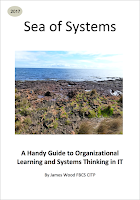
     Check out more great learning tips in my eBook Sea of Systems
    This is difficult but must be addressed, in the fixes that fail example we saw how a successful intervention failed over the mid to long term. 

    There are tools in IT, like post implementation reviews, to record these lessons, but what we really need is to avoid making more mistakes and without thoroughly understanding the systemic impacts  and interconnectedness of our systems we cannot assure that.

    I explore these and other systemic techniques in my eBook Sea of Systems, download it at my blog https://systemsthinkingit.blogspot.com.au


    About  "gems from the deep" takes a quick dive into the more detailed and involved concepts explored in the eBooks Sea of Systems and Transparent Delivery (forthcoming).